Tuesday, October 19, 2010

Shot by Shot

So it took me a while to find something that I felt would work well for this post.  I didn't want to use a completely random scene because I was looking for something that I thought had meaning.  I ended up going with the opening scene from The Departed directed by Martin Scorsese.  One reason that made me watch this film again was the fact that I wanted to decide for myself what made Scorsese such a master of his work.  I know his earlier works are in leagues of their own, but I realized from watching this film that he uses camera movement so effectively to bring about mood and tone.  Almost all of his shots have some sort of movement to them.  The opening scene sums this up pretty nicely.  Another reason I chose this scene was that it goes along nicely with what we're talking about in class; lighting.  On a side note, besides the long list of A-list cast in the film like Dicaprio and Nicholson, I thought it was interesting to see that Brad Pitt was credited as a producer.

The very first shot is a long smooth dolly that lasts about 30 seconds.  It introduces one of the main characters, Frank Costello (Nicholson), with a voiceover to setup what the movie is basically about.  It is set in a dark warehouse that comes back into play toward the end of the scene.


When I mentioned lighting being a key factor, here is the start of it.  The character is completely dark the entire time to make him appear mysterious and mischievous.  The shot starts as a wide angle full body and slowly zooms into the characters profile in a close-up.  Something to take note of in the opening voiceover are Costellos last words in this profile shot.  He says you have to take from people to get what you want.


This is an establishing shot of a middle class Boston grocery store that Costello owns and runs illegally.  This is another long 23 second continuous shot.  I don't think this could be done by a dolly, it has the feel of a crane shot and by the time the camera makes it into the store it seems as if it's hand held.  It sets up the little boy in the green in the frames because he is an important character too.  Notice again how the main character is completely facing away from the camera.  We're still clueless to what he looks like.
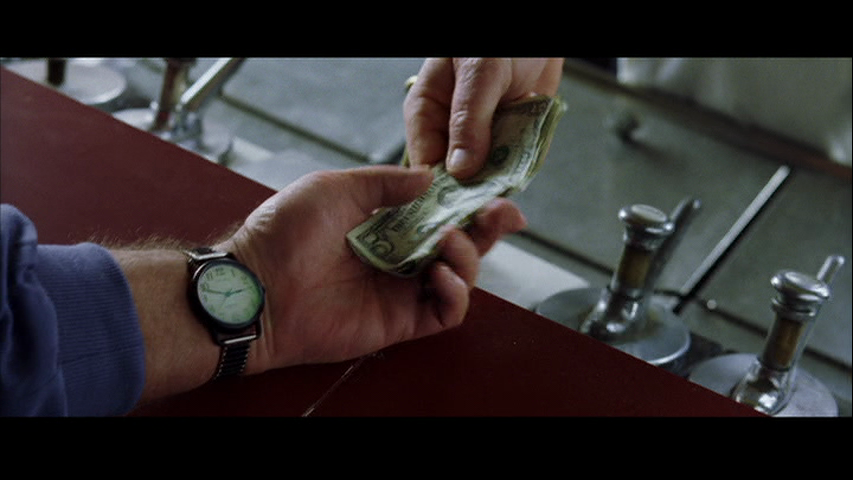
Next shot is a quick cut to a close-up of the cashier handing over money.  Symbolizes that Costello takes all that he can even if it's only a few dollars.

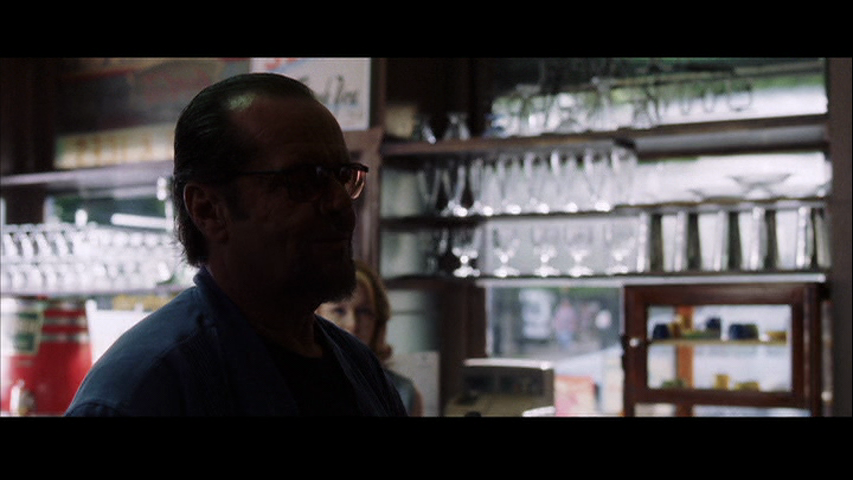
Then followed by a medium shot of the main character and a 3/4 of the cashier.  The only light in the shot is coming through the window in the back left sweet spot.  It draws your attention away from Nicholson but you still try to look at him because he's still dark.


3/4 panning shot of the young girl walking over to Costello.
A quick cut to a medium close-up of the boy watching Costello.


All of these shots flow together quickly into sharp cuts.  Notice how the little boy watches Costello closely.  It ends with this dark, MCU of Costello.
Then it cuts into this Close-up of the boy.  This establishes a relationship between the two characters because it becomes more personal.  He is also framed up nicely using the Rule of Thirds.

Here the relationship is established with a wide shot.  Costello proceeds to buy groceries for the kid as he talks about how the boys dad is dead.


Several quick coverage shots.  Into an ECU of the little boy.


Now we can relate to the boy.  Notice the difference once again in contrast of light between the two.

 Here is a significant CU shot after establishing the relationship between the characters.  Costello is now giving away money to help the boy instead of taking it like earlier from the cashier.  This symbolizes a Father-Son relationship that begins to form.

 A nice OTS MCU of the boy getting a few last words of encouragement from Costello.
 P.O.V of the boy leaving then Costello steps into frame.  Right next to the sweet spot.

 This sequence is how the first 4 minutes of the film start out, but I would like to point out a few more that I like and think are important.

Several minutes later we're placed back into the warehouse from the very beginning.  The lighting scheme is basically the same except now the little boy is present and being "coached" by Costello.  I like this because Costello is so dark he appears to be just a shadow.

 A couple of minutes later, a nice OTS dolly shot of Costello talking to the boy again.


Then finally, the main character finally steps into the light.  He starts off to the side from the left then walks straight into the middle of the frame, all attention on him.  This is a nice way to end the mysterious feel of who the guy may be.  Of course, Nicholoson leaves us with a sly grin.
I enjoyed this assignment because it makes me think about all the things we're learning.  It's a nice feeling to actually understand a lot of the thoughts and processes that go into filmmaking.

Tuesday, September 28, 2010

Portrait Reflection

I haven't had my portrait critqued yet, but I can already talk about a few things that I have learned just from seeing others and working on my own.  I've enjoyed getting to see these other pieces and seeing the creative side of everyone else. A big reason why I liked doing my portrait was because it allowed me to be creative myself.  Often times, I feel like I don't have a chance to come up with ideas and actually see them through so it was a lot of fun being able to get out and work on something. Working my D.P wasn't near as bad, or hard as I thought it could have been.  I felt like we were able to work smoothly together and he was willing to listen to what I had to say.  I was also open to hear feedback and take ideas, so I think it came together pretty well in the end.  I'm looking forward to getting more hands on experience with the next projects.
  I can honestly say that I've learned more so far this semester than I have the past three years when it comes to film and my Tcf classes.  I have always loved watching movies when I have the chance, but before this class I wasn't able to notice things like I can now.  This goes along with seeing the other projects.  I like being able to notice things such as depth of field, exposure, lighting, color, etc. when I watch different pieces.  I still feel as if I overlook a lot of things, but it's nice to pick out these technical aspects while I'm watching.  I remember the Rule of Thirds from 201, but I wasn't able to put it into use like I can now.  I try to think of this when I'm filming, and it's one thing I try to notice in others too.  The same with depth of field and the vertical lines that show depth.  I've always wondered how to "trick the eye" into focusing on a certain subject and now it's great to understand it.  Hopefully I'll be able to take what I get from my critique and put it to good use in the future.

Tuesday, September 21, 2010

Wednesday, September 15, 2010

My Camera Sense

To be honest, I really have no true experience with either of the cameras we are using in class.  This goes along with what I mentioned in my last blog about how my experience is kind of what holds me back.  It was a year ago this semester that I had my first hands on Tcf class.  It was 201, with Nathan Dains.  We only used the PD-150 and without bs'in around, I didn't like them very much.  At the time, I thought they were impressive and I felt pretty knowledgeable once I knew how to work one.  I was able to check one out for CMF in the Spring, and I also thought it was a big deal to be using a bigger and "better" camera than the little HD given to us.  Compared to what I've already seen with the cameras we get to use now, I feel like the 150s are a league behind.
  I think the biggest difference for me is going to be using the cards vs. the tape.  Logging and capturing was always such a hassle for me because something was bound to go wrong every time.  I'm excited to be able to get away from that for the most part and use the cards with the JVC.  I also like how the size of the JVC is smaller and easier to handle.  I've already learned a lot from being able to film the little bit that I have so far.  A lot of what we have covered in a few weeks I never learned from my 201 class last year.  It's nice to finally be able to get back to being hands on again.

Wednesday, September 1, 2010

Being a Filmmaker

  It wasn't until second semester of my Sophmore year that I realized I wanted to be a film major.  Up until then, I had always been fascinated with movies, especially the acting side of things, and growing up that's what I wanted to do.  My problem was I never knew how or what to do to get involved with any of it.  I joined the Drama club my Senior year of high school and I took another acting class here my Freshman year.  Although I loved being able to act, I just didn't feel like it was the right thing for me.  I stayed in the Business college my first two years and wasn't satisfied, but luckily I came across CMF in the spring of '09.  It was Campus Moviefest that really turned things around for me, and I realized that if I couldn't be on screen then why not be behind it.  (Even though I acted in both shorts ha) 
  After doing CMF the past two years and taking Tcf 201, I was able to get a feel for what I was really interested in.  Of all the different aspects, I took a liking to the art of editing.  When anyone ever asks what I want to do one day with film, my answer is to work with post-production on putting a movie together.  Of course I love being on set, and ultimately that would excite me more than anything, but I have one problem . .  My experince . .  The only thing that discourages me about pursuing film 100% as a career goal is my Lack of experience.  I feel like if I did have more experience, or at least been exposed to more opportunities besides CMF and 201, then I would feel more comfortable with what I'm doing.  That is the number one thing I believe I am going to take out of this class and my other Tcf class also.  I hope to learn everything I can about the entire process of filming/vidoegraphy, and basically everything I see and do is new to me.  My main goal for this course is to be able to feel Comfortable standing behind a camera and using the tools necessary to depict an awesome shot and set up the right lighting.  Aside from the actual filmmaking process, I still contemplate heavily the idea of becoming an Entertainment lawyer.  I believe I would be good at it, and with this training I could understand a lot about the industry I'm working in.